
JOINT FLHS/FULS VISIT TO THE BOYNE VALLEYBATTLE OF THE BOYNE CENTRE & MELLIFONTABBEY
After a lapse of a number of years we decided to reactivate our joint FLHS/FULS visit and make a joint trip together. The visit took us to the Boyne Valley, an area in Ireland’s Ancient East renowned for its rich heritage. Our trip took us to the Battle of the Boyne Centre at Old Bridge and the Cistercian Abbey of Mellifont.
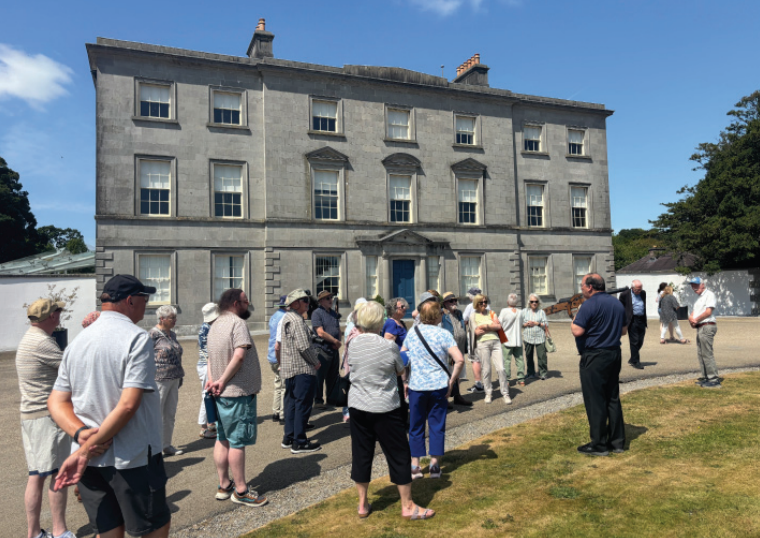
The Battle of the Boyne Centre offered an immersive experience of the 1690 battle between King William III and King James II, with exhibitions, historical re-enactments and scenic walks. This pivotal battle helped shape the political and religious landscape of Ireland and in fact that of Europe. The site included the restored 18th century Mansion, stable yard, walled gardens and extensive parklands.
Mellifont Abbey was the fi rst Cistercian foundation in Ireland and became one of the wealthiest religious foundations in the country. The Abbey is located in the Mattock valley, a tributary of the river Boyne. Founded by St Malachy in 1142 the Abbey ruins feature some notably architectural features. All the essential components of the abbey are evident including the Cruciform Church, the Chapter House and Cloisters. Still visible and intact is the unique Lavabo, an exceptional octagonal building and one can enjoy a walk in the serene settings of the Abbey ruins. The site is fully accessible for visitors with disabilities and offers a unique glimpse into Ireland’s medieval monastic life and heritage.

It was a beautiful sunny morning when we all met at Old Bridge House in the Battle of the Boyne Centre. We had a total of thirty-three members from both federations, fourteen from FULS and nineteen from FLHS. We had used our own transport to travel and the centre’s tea rooms were an ideal spot to meet and enjoy some refreshments before the start of our organised tour. With great anticipation we were all met at 12.00 noon by our OPW Guide, Noel French, in the courtyard adjacent to Old Bridge House and facing onto the actual battlefi eld itself. Noel proved to be something special and a wonderful guide. He was a wealth of information, not only about the battle, but he also painted a fascinating picture of what was happening militarily across Europe at the time. His infectious personality and enthusiasm for the subject brought the whole story to light in a fascinating way. This we were able to do while viewing the scene of the battle and imagining what it might have been like for the contestants on that fateful day.
We then moved indoors to the centre’s auditorium where Noel continued the story with the help of some exhibits and artefacts from the battle. The presentation concluded with a most interesting audio-visual fi lm depicting the battle and its highlights. So ended a most interesting, absorbing and informative morning experiencing the unique Battle of the Boyne story. Meal time beckoned and it was not long before we had to reluctantly leave Old Bridge for our date with Donegan’s famous Monasterboice Inn. We were not disappointed and found a very warm welcome at the Inn with some friendly and helpful staff. The meal was excellent and most welcome.

Mellifont Abbey awaited us and again we were not to be disappointed as we arrived to see the Abbey radiant in all its glory in the afternoon sunshine. We were met and greeted by two friendly and lovely ladies, Maeve and Karen who set the scene for the wonderful visit that was to follow. Mellifont has a very interesting indoor museum which includes some 3-D models of the Abbey as it would have been in its heyday, also very informative display boards and various recovered stone artefacts from the Abbey itself.
Armed with this introduction we then met our OPW Guide, Karen, for our guided tour of the site. Karen was an excellent guide with an extensive knowledge on all aspects of the Abbey. By way of introduction, she outlined the history and background of the Cistercians worldwide and then their coming to Ireland and the impact they had on society and the community. She recounted many interesting stories not least of all the important role played by bees and honey in monastic life. The bees were a source of honey from which the Monks produced mead and also very importantly, beeswax for making candles. The beeswax was unique as it did not produce smoke or soot.

The guided tour took us to all the interesting locations on the extensive Abbey ruins. There are many architectural features still visible, and it was absorbing to enter the 14th century Chapter House with its arched ceiling and its unique 13th century floor still intact today. It was surreal to listen to the medieval chanting being played in the background during our visit. With excellent commentary from Karen, we learned much about the monastic life of the monks and their daily life. There were many examples of unique carved stones on which there were some mason’s marks still visible. Karen pointed out the locations of the Abbey Refractory and the Infirmary once used by the monks, and we were able to have a peek at the Calefactory site. I suppose the highlight of the visit was arguably the unique Lavabo. Resplendent in the afternoon sunshine beside the remaining Cloisters, it presented a stunning picture. This octagonal shaped building is the only one of its kind in Ireland, a medieval washroom and an outstanding example of Romanesque architecture.
It was a wonderful day spent in the enchanting Boyne Valley and accompanied by some beautiful weather to boot. It was time to say our farewell to the lovely Boyne Valley, bid each other adieu and head for home. What better way to reactivate our joint North/South exchange visits.

Comments